Leveraging advanced tokamak design, Japan’s FAST Project takes a major step toward sustainable fusion energy
Tokyo, Japan) FAST Project Office proudly announces the launch of the FAST (Fusion by Advanced Superconducting Tokamak) project, a groundbreaking initiative aimed at achieving fusion-based power generation* by the end of the 2030s.
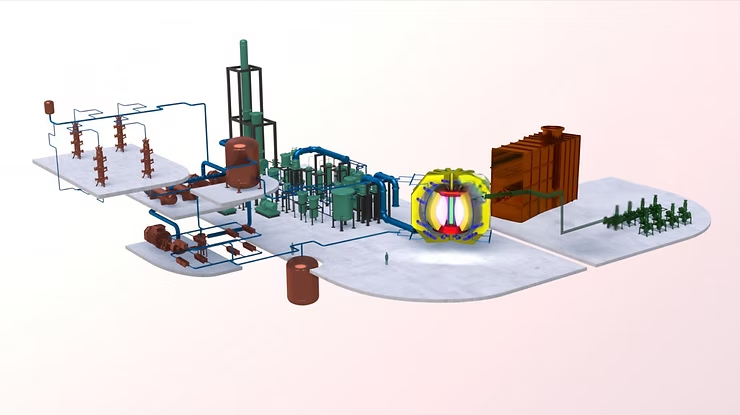
FAST, to be sited in Japan, aims to generate and sustain a plasma of deuterium-tritium (D-T) reactions, demonstrating an integrated fusion energy system that combines energy conversion including electricity generation and fuel technologies. The project will employ a tokamak configuration, chosen for its well-established data and scalability. Targeting a power generation demonstration by the end of the 2030s, FAST will address remaining technical challenges enroute to a commercial fusion power plants. Bringing together top researchers from prominent institutions, along with industrial and international partners from Japan, the UK, the U.S., and Canada, FAST is set to make a major impact on the global fusion energy landscape.
*Note: Power generation here refers to producing energy from fusion reactions, though it does not imply net positive power production where electricity output exceeds electricity consumption.
List of Key Researchers Involved:
- Professor Akira Ejiri, The University of Tokyo
- Professor Yuji Hatano, Tohoku University
- Professor Kenji Tobita, Tohoku University
- Professor Yasushi Ono, The University of Tokyo
- Associate Professor Hiroaki Tsutsui, Institute of Science Tokyo
- Professor Takaaki Fujita, Nagoya University
- Professor Hitoshi Tanaka, Kyoto University
- Professor Satoshi Konishi, CEO of Kyoto Fusioneering Ltd.
- Professor Kazuaki Hanada, Kyushu University
- Professor Yuichi Takase, Tokamak Energy (UK)
- Dr. Masayuki Ono, Princeton Plasma Physics Laboratory (U.S.)
- Dr. Brian Grierson, General Atomics (U.S.)
- Dr. Sam Suppiah, Canadian Nuclear Laboratories (Canada)
- Dr. Ian Castillo, Fusion Fuel Cycles Inc. (Canada)
Industry-Academia Collaboration and Welcoming New Partners
FAST project will advance through collaboration with key universities and research institutions both domestically and internationally. Moving forward, a conceptual design team will be organized, composed of plasma researchers and power plant engineering researchers. The preliminary design is expected to be completed within the year 2025. A thorough evaluation of the internal and external environment, including technology, funding, regulation and policy, will be conducted at the transition to detailed design, where a decision will be made on the feasibility of execution.
In parallel, led by Kyoto Fusioneering, we will accelerate technology development in key systems, engineering design, site selection, and regulatory efforts in collaboration with industrial partners such as Mitsui & Co., Ltd., Mitsui Fudosan Co., Ltd, Mitsubishi Corporation, Marubeni Corporation, Fujikura Ltd., KAJIMA CORPORATION, and Furukawa Electric Co., Ltd. We will continue to actively welcome researchers, industrial partners, including companies participating in J-Fusion, and international collaborators to join and contribute to the project.
Motivation for FAST
FAST addresses key technical challenges essential for advancing fusion energy to achieve a carbon-neutral society. While previous or near-term planned fusion experiments have achieved, or will soon achieve, medium-pulse plasma discharges to de-risk the plasma confinement and control for a Fusion Pilot Plant (FFP), critical obstacles remain in harnessing the energy transport for sustained external use, establishing the tritium fuel cycle, including tritium breeding, and integrating these advances into a configuration that represents a commercially viable fusion power plant. At present, no experimental device worldwide is capable of creating the necessary fusion environment—the fusion neutron flux and relevant thermal loads—to bridge the gap between the advanced plasma experiments of today and the desired end goal of practical energy extraction.
FAST aims to fill these gaps by providing a comprehensive and unique platform to develop technologies applicable to practical fusion power plants worldwide, including demonstration devices (DEMO) and fusion pilot plants (FPPs). Building on Japan’s strong foundation of fusion science and high-tech manufacturing, the project will drive maturation across the entire fusion energy supply chain, delivering critical advancements that pave the way for a fusion energy industry in the coming decades. FAST is poised not only to provide a key step in the realization of fusion energy but also to significantly enhance the industrialization of fusion technology.
Global Background and FAST Project’s Role
While countries such as the U.S., the UK, and China are making significant strides in fusion energy industrialization, Japan is accelerating its development through the Fusion Energy Innovation Strategy, aiming to demonstrate power generation by fusion by the end of 2030s. As part of this national vision, FAST seeks to advance fusion power generation from Japan, aligning with the country’s ambitions for sustainable energy. Beyond its national role, FAST is positioned to contribute to the next global fusion milestones, supporting international efforts to accelerate fusion energy deployment worldwide.
Key Technical Milestones
FAST tackles fundamental challenges in fusion energy, including:
- D-T Fusion Reaction: Produce, sustain, and control an eternally driven deuterium-tritium (D-T) plasma by fusion reactions maximizing the neutron flux available for component testing.
- Energy Conversion: Develop technologies to efficiently extract and utilize fusion energy including electricity generation.
- Tritium Breeding and Fuel Cycle: Demonstrate a closed D-T fuel cycle, including tritium breeding and extraction, processing and refueling.
- Fusion System Integration: Fully integrate all fusion power plant systems, including energy extraction and utilization, heat management, and safety protocols to ensure reliable and sustainable operations.
FAST Technical Overview
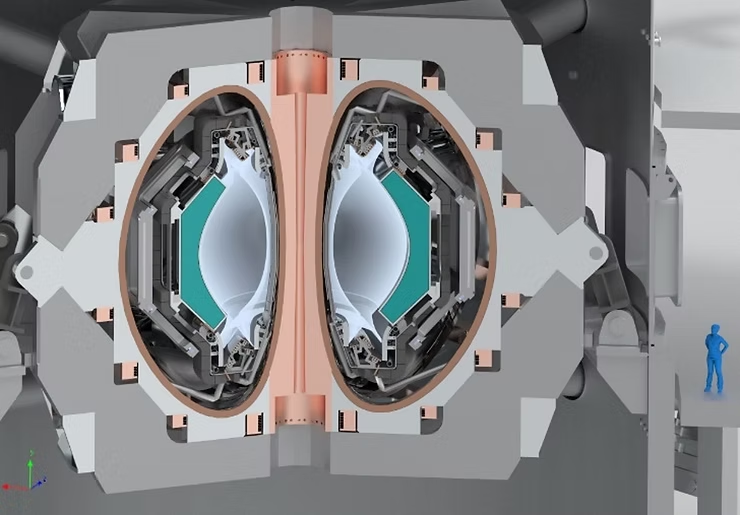
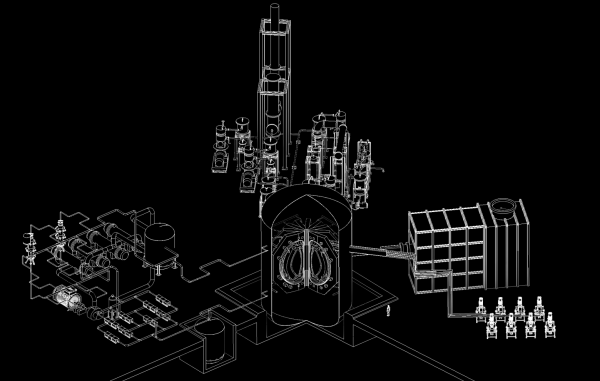
Cross-sectional drawing of the FAST device. Plasma cross section, vacuum vessels, blanket modules and magnetic coils for continuous power generation are shown.
FAST adopts a tokamak configuration – a well-established plasma confinement method with the most extensive database and specifically employs a low-aspect-ratio tokamak design, and high-temperature superconducting (HTS) coils, which enables a compact design allowing lower costs and a shorter construction time. The system aims for a power generation of 50 to 100 MW and a discharge duration of 1,000 seconds of D-T fusion burn. High-temperature blankets enable testing of multipurpose uses for thermal power and neutrons. The device is planned to operate for a cumulative 1,000 hours of full-power operation.
Key Design Parameters:
- Major Radius: 2 – 3 m
- Minor Radius: 1 – 1.5 m
- Magnetic Field Strength: 3 – 4.5 T (with HTS magnet)
- Line Average Density: (1 – 2)×10^20 m^-3
- Normalized Beta: 3.5 – 4.5
- Ion Temperature:~20 keV (200 million ℃)
- Plasma Current: 6 – 10 MA
- External Heating Systems: Neutral Beam Injection (NBI) and Electron Cyclotron Heating (ECH)
- Confinement Improvement Factor: 1.2 – 1.5
- Fusion Power: 50 – 100 MW (a discharge duration of 1,000 s)
For more details and inquiries, please visit our website or contact Starlight Engine Ltd:
company@sle.energy