Fusion Drivers Vol.3
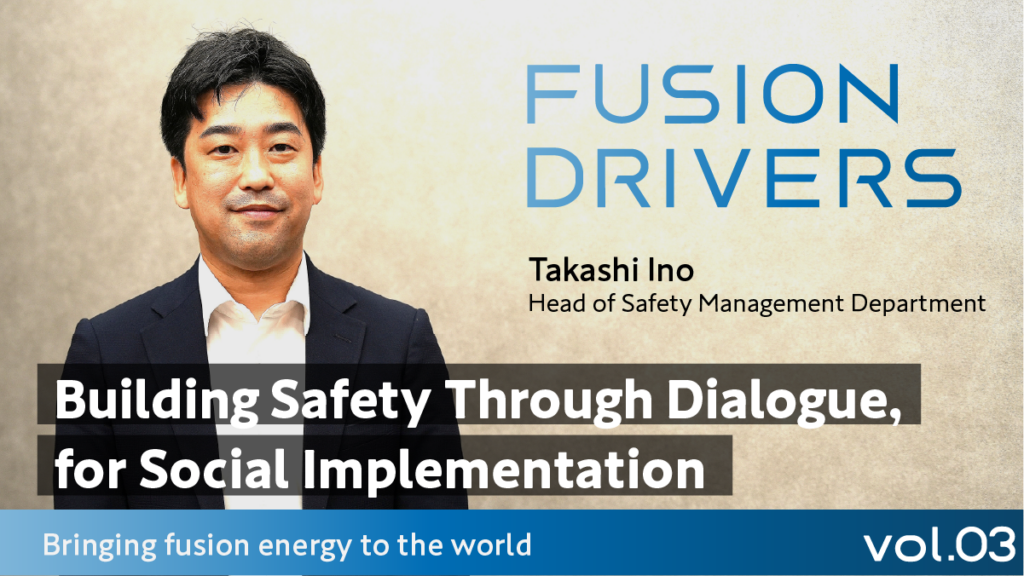
Mr. Takashi Ino, Head of Safety Management Department
Fusion Drivers – Bring fusion energy to the world – is an interview series featuring the team members who work at Starlight Engine. In this third installment, we introduce Mr. Takashi Ino, who is responsible for safety assessment, risk communication, and regulatory and licensing affairs—work that is essential to the social implementation of fusion energy.
After working in the nuclear power industry, Mr. Ino moved into the fusion energy industry, where he has worked on safety assessment and risk communication. He is an expert in this field. We asked him how he approaches his work each day, and what kind of colleagues he hopes to take on this challenge with.
A Constant Commitment to Social Implementation
Q. To start, could you tell us about your role?
In a word, my work is about safety. For fusion energy to be implemented in society, there is a great deal that must be done on the road to practical use. For example, we need to analyze its potential impact on society and the public in advance, and communicate with a wide range of stakeholders about safety measures and risks. From my position in safety, I focus mainly on risk communication toward social implementation.
This year, I transferred to Starlight Engine (SLE) from our group company, Kyoto Fusioneering (KF). KF is one of the world’s leading companies delivering fusion technology to global markets. SLE, on the other hand, is in my view the company responsible for envisioning the future in which that technology takes root in society, and for making that future a reality.
The social implementation of fusion energy requires acceptance from many stakeholders, including the national government, local governments, and local residents. Safety is the key point here. That is why I feel that careful communication in this area is one of the important roles SLE is expected to play right now.
Social implementation also requires building foundations beyond technology, such as legal frameworks, site selection, and a platform for industrial collaboration. SLE cannot accomplish these efforts on its own; they require collaboration with a wide range of parties.
For this reason, I place great importance on the perspective of external communication. I focus not only on what we communicate, but also on the analysis and research that underpin it, and on putting the right internal structures in place. To help SLE become an organization that society trusts, I value every opportunity to exchange views and engage in dialogue.
Q. What has your career looked like so far?
My career began at The Japan Atomic Power Company, which specializes in nuclear power. For my first three years there, I worked on site at a power station. Accident-response drills were conducted on site, and I watched up close as my supervisors and senior colleagues instantly assessed complex events from alarms and early signs in plant parameters, then took action to bring the plant to a safe state. Through that experience, I learned that ensuring the safety of a plant—a complex system—depends on “designs that let people on site act without hesitation” and “systems built around the realities of the site.” Even as a new employee, I came to see these as the foundation of safety.
After the Great East Japan Earthquake, I became involved in safety analysis (evaluating the effectiveness of countermeasures) and accident-response procedures. Because an accident at a power station cannot actually be reproduced, analyses are performed in advance to evaluate whether safety measures will work effectively. I developed accident-response procedures in coordination with the station’s operators, incorporated them into the analyses through discussions with manufacturers, and confirmed the effectiveness of the safety measures. I was also responsible for compiling the results and explaining them to the regulatory authority. Analysis results and safety measures also influence discussions on national and local disaster-prevention plans, so I often had opportunities, as the technical lead, to explain accident scenarios and risk assessments.
Later, when the licensing work for the power station I was in charge of reached a milestone, I asked to be involved with the Fukushima Daiichi Nuclear Power Station. I was then seconded to the Nuclear Damage Compensation and Decommissioning Facilitation Corporation (NDF), a government-authorized corporation. At NDF, I was responsible for risk analysis related to decommissioning. The decommissioning of Fukushima Daiichi is an unprecedented undertaking that involves many uncertainties. At the same time, the work must move forward in order to steadily reduce future risks. For that reason, communicating the progress of the decommissioning work and the risks associated with the plans to society in an easy-to-understand way was also an important part of my role. Through academic societies and other forums, I studied risk analysis methods and approaches to weighing multiple types of risk, such as radiation risk, cost, and schedule. At the same time, I worked on site-oriented approaches to ensuring safety and on communicating about risk to society.
NDF brought together excellent engineers, and working alongside people from diverse backgrounds—including government agencies, power companies, manufacturers, and trading companies—was also a valuable experience.
Driving Change Through Dialogue with Society
Q. That sounds like extremely important and rewarding work. What led you to join KF, and then SLE?
As my secondment to NDF was coming to an end, I began to rethink my future career. When I looked at the world from a broader perspective, without being bound by my past experience and expertise, I realized that I wanted a real sense of moving society forward through new technology. In my job search, I placed particular emphasis on whether “the technology is actually moving society.” Without limiting myself to specific fields such as mobility or life sciences, I had the opportunity to talk with people at many companies, and several of them actually reached out to me with offers.
It was then that I came across Kyoto Fusioneering (KF). At the time, fusion energy was, to me, the most ambitious field—and, to be honest, one whose full picture I could not see. At the same time, I was strongly drawn to the fact that fusion is a technology with the potential to help solve global challenges, and that KF was the only private company in Japan seriously working to realize it. I was also very attracted by the fact that KF aimed not only to develop technology but also to implement fusion energy in society as a business, and that it was looking beyond Japan to the global market. So I contacted the then-president myself, and ended up joining the company.
While working on a variety of tasks at KF, I also had the opportunity to be involved in FAST, a fusion energy power generation demonstration project. Through that work, I came to feel even more strongly how exciting the challenge of bringing technology into society is. I then transferred to Starlight Engine (SLE), the entity implementing FAST. I am now working on activities to achieve the social implementation of fusion energy.
Q. For the general public, the difference between conventional nuclear power and fusion energy can be hard to understand. Could you explain it?
Conventional nuclear power (fission) and fusion energy (fusion) differ fundamentally in the principle of the reaction that produces energy.
Nuclear power uses a nuclear reaction (a fission reaction) that occurs when neutrons collide with heavy atoms such as uranium. The neutrons released by this reaction trigger further fission reactions, creating a chain reaction. Energy is extracted safely and stably by controlling this chain reaction.
Fusion energy, by contrast, produces energy by fusing light atoms together. This requires continuously maintaining plasma at extremely high temperatures. If the conditions for sustaining the plasma are disrupted even slightly—for example, if the device loses power or the fuel supply is cut off—the reaction stops. Because fusion is not a chain reaction, sustaining the reaction is difficult. On the other hand, this also means that the reaction stops when an abnormality occurs.
That said, I don’t want to simply claim that fusion energy is safe because it is fusion. Nuclear power plants, thermal power plants, and chemical plants all require safety measures suited to the characteristics of their respective technologies and facilities. The same is true of fusion energy: safety design and operation suited to its characteristics are essential.
I believe we can draw on a wide range of knowledge, including the research results accumulated to date, the approach to radiation protection developed in the nuclear field, and know-how in plant design and operation from other industries. Another important element is communication with society. I believe safety cannot be established through technology alone; it becomes possible only with society’s understanding and trust. Different stakeholders have different interests and concerns. It is therefore essential to engage in careful, continued dialogue about the characteristics and risks of fusion energy and our approach to ensuring safety.
Incorporating Outside Perspectives from the Earliest Stages
Q. When explaining your work externally, how do you approach communication, including governance?
That is a very important point. My view is quite simple: what matters most is creating an environment in which members of society can frankly share their opinions and concerns with us.
One approach is to provide external explanations and apply for permits only after the design is completely finalized. Instead, I believe it is important to engage repeatedly with regulators and local governments from an early phase—while we are still in the design stage and considering sites (construction locations).
Meeting regulatory standards in the future is a given, but that alone is not enough. I think it is important to move forward while seeking input from stakeholders at an early stage, even on the overall direction of how we will ensure safety. I believe that sharing our review process and moving forward through discussion is itself a way of ensuring governance.
When it comes to safety, it is important to demonstrate technical feasibility and scientific grounds, and to explain the validity of the design and operations. Equally important, however, is sharing the process: why we chose a particular safety measure, and what discussions led us to that conclusion. Starting from the question of what philosophy should underpin our safety measures, I want to build them together with stakeholders rather than keep the discussion closed within the company.
In fact, for FAST, we have been holding ongoing exchanges of views with the regulatory authority since last fiscal year. Having opportunities for this kind of dialogue before the design is fully finalized is extremely valuable. I believe these accumulated efforts will form the foundation for future relationships of trust and for governance.
Q. So you are steadily building trust with the regulatory authority. What about local governments and academia?
With local governments, our communication mainly concerns the selection of a site (construction location). I proactively raise topics related to safety and risk to keep the dialogue going, and I also make a point of sharing what we have discussed with the regulatory authority.
In academia, I participate in a specialist committee on the risks of fusion energy, which was established within a fusion energy–related organization of the Atomic Energy Society of Japan (AESJ). As a committee member, I have taken part in many discussions. We discuss not only, from an engineer’s perspective, “how to move the technology forward,” but also more objective questions such as “how society perceives a new technology called fusion energy, and how social acceptance should be built.”
Japan’s technological foundation for fusion energy has been built through many years of research by research institutes such as the National Institutes for Quantum Science and Technology (QST), as well as universities and academic societies. In recent years, private companies like ours that focus on the social implementation of fusion energy have begun to emerge. The FAST project that we are pursuing cannot be achieved by a single company. I believe it can be realized only through industry–government–academia collaboration that leverages the technological foundation and research results built up so far while also keeping the future supply chain in mind.
In that sense, it is extremely important for people in diverse positions to discuss issues together and deepen mutual understanding. In fact, discussions about fusion energy have become much more active over the past few years, and views on safety are now being exchanged in a variety of forums. I see this expansion of communication as a major step forward toward the social implementation of fusion energy.
Q. It sounds like you communicate with a very wide range of parties. What does your team look like, and how do you work?
Since we opened our Marunouchi office in June this year, we have had more opportunities to communicate face to face. Within the company, there are members with different areas of expertise, such as safety assessment, regulatory affairs, site development, and civil engineering and construction. I work in close collaboration with these members every day.
Communication with external parties is also very active. To be honest, we are engaged in so many different discussions in parallel that I can barely keep up with organizing my thoughts. While keeping the perspectives of safety and risk communication in mind, I value dialogue with people who hold diverse opinions. Another important part of my role is to feed back the insights and opinions I gain outside the company, discuss them with each specialist team, and reflect them in the project.
In addition, experienced technical members are joining SLE one after another, and each of them starts leading the project soon after joining. I learn a great deal even from casual conversations, and I find it very stimulating. Our strategy and communications members, as well as our corporate members in operations, HR, and labor affairs who build the company’s foundation, all approach their work every day as professionals. Through daily communication, I truly feel that SLE as an organization is supported by many professionals.

Social Implementation Needs People from Many Different Backgrounds
Q. What makes SLE an appealing place to work? And what kind of people would you like to see join SLE?
The greatest appeal of this work comes down to the fact that fusion energy has the potential to change society dramatically. Over the past few years, government initiatives and the environment surrounding the industry have changed significantly, and I find it rewarding to work amid such dynamic trends.
Fusion energy is also a field with a very broad base. For that reason, I would really like people who want to contribute to realizing fusion energy while leveraging their own expertise to take an interest in us. Please see our job postings for details. SLE is recruiting for a wide range of positions—not only technical roles, but also roles in the corporate division that supports the company’s foundation, and members who plan and execute business strategy.
In fact, within the company, there are people who excel at using their communication skills to move teams forward, and others with a craftsman’s temperament who dig deep into a single theme and steadily produce results over time. Members with a variety of backgrounds and strengths are thriving here, so there is no fixed profile of “the type of person you have to be.”
What matters, I think, is feeling excited by the challenge of building a new industry while drawing on your own expertise and experience. I would be delighted if you would first take an interest in fusion energy and SLE, and then feel free to apply.
Q. Finally, do you have a message for future team members?
What we are taking on is not simply completing our own device. I believe our challenge is to create, from Japan for the world, a common foundation that allows fusion energy to truly take root in society and continue to develop sustainably.
Above all, what I want to convey is that “now is the time to take on this challenge.” The environment surrounding fusion energy has begun to change significantly. National policy is getting into full swing, and concrete discussions on developing laws and regulations and on social implementation are moving forward. We are truly at a historic turning point. Being directly involved at this moment and building the rules and systems for the energy of the future from scratch is not an experience you can have at any time. Even if you were to join the same industry ten years from now, there are challenges that can only be experienced right now.
We want to shape the energy of the future with our own hands. We want to create new value for society. I would love to take on this challenge together with people who share that passion.