Fusion Drivers Vol.1
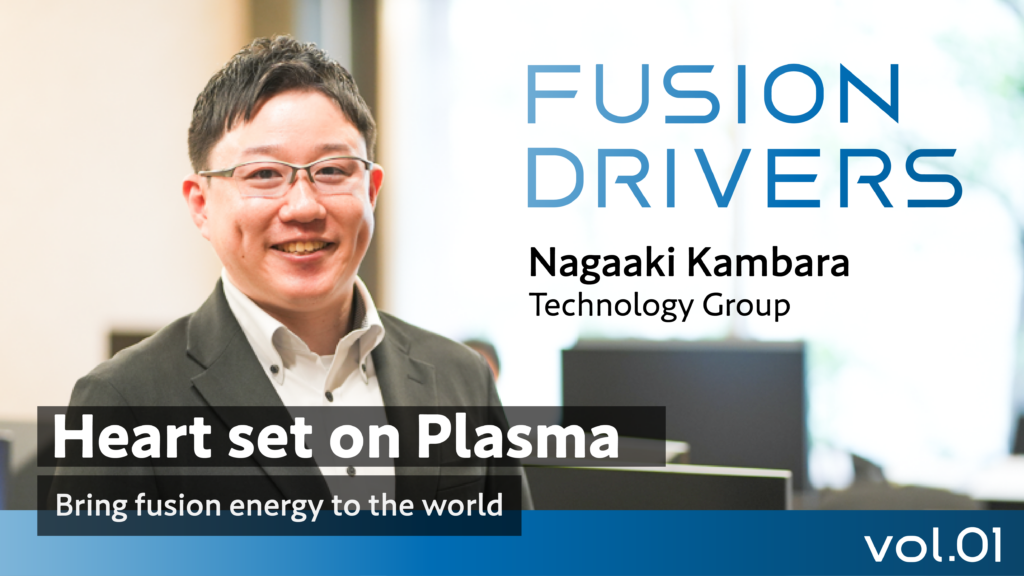
Mr. Nagaaki Kambara, Technology Group
Fusion Drivers – Bring fusion energy to the world – is an interview series featuring the team members who work at Starlight Engine. In this first installment, we meet Nagaaki Kambara, a plasma diagnostics engineer.
After building a career across academia and industry, Kambara chose to join a fusion startup. He shares the path that brought him to Starlight Engine – and the enduring fascination with plasma that has shaped every stage of his work.
A Passion for Plasma That Began as a Student
Q. Could you begin by telling us about your career so far?
As a graduate student in the Department of Astronomical Science at The Graduate University for Advanced Studies, SOKENDAI, I researched highly charged ions (HCIs), which form when atoms such as iron lose many of their electrons in high-temperature plasmas such as the solar corona. Emission lines from these ions provide important diagnostics of plasma conditions. I studied their spectroscopic behavior using theoretical and modeling approaches, carrying out my research at the National Institute for Fusion Science (NIFS) under the guidance of researchers specializing in spectroscopic modeling.
To test the models experimentally, I used plasmas generated in the Large Helical Device (LHD), a superconducting helical device at NIFS used for magnetic-confinement plasma research. LHD is equipped with a wide range of diagnostics, including multiple methods for measuring electron density. I injected solid iron pellets into the LHD plasma. The hot plasma ablated and ionized the pellet material, forming highly charged iron ions. I measured the resulting emission-line spectra in the EUV region and compared them with the model predictions to evaluate the model.
After graduate school, I joined a company that developed and manufactured extreme ultraviolet (EUV) light-source systems for the semiconductor industry. EUV lithography uses short-wavelength EUV light to pattern increasingly fine features for advanced semiconductor devices. The masks used in this process also require actinic inspection with EUV light to detect defects, and I joined the company to work on the light-source systems used for that purpose. These sources rely on radiation from highly charged ions – the same kind of ions I had studied – so I saw a direct connection with my research and believed I could apply what I had learned.
I worked on EUV source development for some time. When the company’s R&D priorities evolved, I began considering the next stage of my career. I wanted spectroscopy to remain central to my work, and while looking for that environment I was offered an opportunity at The University of Tokyo. There, I worked on spectroscopic analysis and measurement at NanoTerasu, a state-of-the-art synchrotron radiation facility.
Q. What led you to leave The University of Tokyo and join Starlight Engine?
At The University of Tokyo, I continued to work in spectroscopy, but the samples were solids and liquids, and I no longer had opportunities to work with plasma. I came to realize that plasma was the one thing I did not want to give up. That led me to join Starlight Engine (SLE), where I could return to working with plasma through the pursuit of fusion energy.
This may be a slight detour, but there is a reason I care so much about plasma. In a sense, I have been captivated by plasma physics. (Laughs.) We rarely encounter plasma directly in everyday life, yet many astronomical objects – including the Sun, other stars, nebulae, and galaxies – reveal plasma or plasma-related phenomena through the light we observe. To me, plasma is one of the most tangible ways of encountering the cosmos, and there is something deeply romantic about that. I also like that the word Starlight is in the company name. It evokes the light from stars and plasma, and it resonates strongly with what has fascinated me throughout my career.
That fascination led me to explore a broad range of companies working with plasma. I chose SLE because plasma is indispensable to fusion energy and because I felt the company was confronting the challenge head-on. I was particularly drawn to its commitment to plasma generation itself and its effort to build the computational and control capabilities needed for spatially extended, magnetically confined plasmas. That seriousness came through clearly in both the job posting and the interview process.
Another decisive factor was the scale of the plasma – and what that scale makes possible to observe. In my previous industry role, I worked with EUV-source plasmas roughly tens to hundreds of micrometers across. At that scale, obtaining spatially resolved measurements was difficult; in much of my work, the plasma was effectively an unresolved source. Magnetic-confinement plasmas are much larger: their spatial profiles and internal structure can be resolved and analyzed. The contrast feels a little like astronomy. We can resolve structures across the Sun, whereas distant stars generally appear as unresolved points of light. The opportunity to observe a plasma as a spatially structured object, rather than only as a whole, is genuinely exciting to me.
SLE’s work is designed around plasma from the outset, and the company is making a serious effort to generate and control such plasmas. During my job search, I spoke with a range of organizations, including other fusion startups. Based on those conversations, SLE left me with the strongest impression that it was engaging seriously with plasma. That personal impression was one of the main reasons I decided to join.

An Environment for Sustained, Focused Development
Q. Since you have only recently joined SLE, what can you tell us at this stage about your expected work and the size of the team?
The details are still taking shape, but I will be working on plasma diagnostics.
We are also still building the team, so its final size has not yet been determined. If this article interests you, I hope you will consider applying and joining us in building the team.
Q. What makes SLE an attractive place to work for people considering joining?
Beyond its serious engagement with plasma, I am drawn to SLE’s focus on one clear technological goal: realizing fusion energy.
Because plasma is inseparable from that goal, I felt SLE offered the continuity of technical focus I was looking for.
In diversified companies, R&D priorities can naturally change as business strategies evolve. SLE is a startup, yet it is undertaking large-scale development against the backdrop of growing national policy support for fusion energy in Japan.
And because realizing a fusion power plant is at the core of its business, plasma remains fundamental to the work.
For me, that creates the confidence to immerse myself in development and experimentation, and to stay close to a demanding technical challenge over the long term.
Q. How would you describe SLE’s culture? What qualities or mindset seem to fit the company?
SLE has a candid, approachable culture, and it is easy to speak with anyone. People make decisions and act quickly. In my case, I left for a business trip to the United States just two days after joining. (Laughs.) The trip had, of course, been arranged in advance, but the pace still felt distinctly startup-like.
At the same time, many colleagues have already built substantial careers in their respective fields, which gives the company a calm, grounded atmosphere that differs somewhat from the stereotypical image of a startup.
The range of stakeholders is also unusually broad: we communicate with policymakers and government agencies, major industrial companies including heavy-industry manufacturers, and researchers from many institutions. As a result, SLE combines startup agility with a real sense of responsibility and professionalism.
In terms of mindset, I think SLE is an especially good fit for people with a deep commitment to their own field. I would certainly like people who are interested in plasma to get involved. More broadly, I hope people will join who are confident that the skills and technologies they have developed can contribute to fusion energy.
Realizing fusion energy requires far more than plasma expertise, even though plasma is the heart of a fusion plant. It calls for a wide range of capabilities, including plant construction, component and equipment development, materials, manufacturing, and processing technologies.
I would like to work with people who think proactively about how their expertise can contribute and can say with confidence, “My skills can make a difference here.”

A Message to Future Teammates
Q. Finally, what message would you like to share with people reading this article?
I believe from the bottom of my heart that we will be the ones to make fusion energy a reality. If you are serious about taking part in that work, I believe joining SLE is one of the most direct paths available.
If you share that commitment, I hope you will apply.
Even if your current field appears unrelated to fusion, your skills or expertise may have a valuable role to play. An informal conversation is a perfectly good place to start. If you are even a little interested, I hope you will consider applying. I look forward to the day we can work together.
Starlight Engine is looking for people who want to help realize fusion energy with us.
View current openings: https://herp.careers/v1/sleenergy