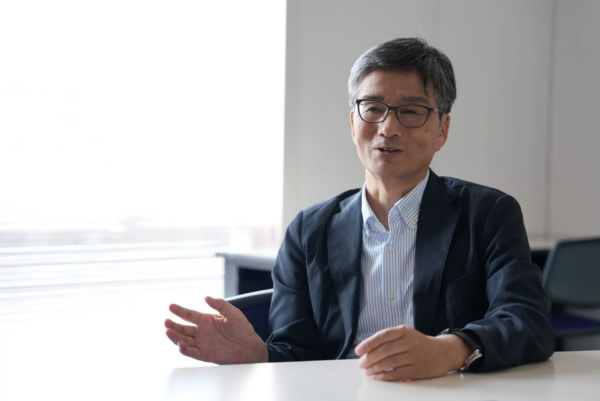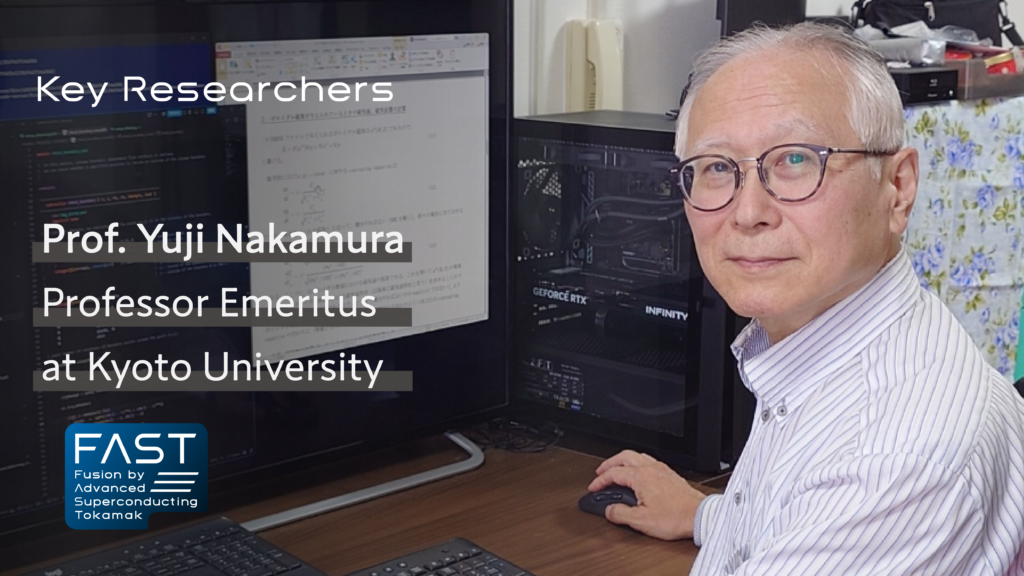
Professor Yuji Nakamura, Professor Emeritus at Kyoto University, is currently a member of the Technical Group at Starlight Engine. Drawing on decades of experience in plasma theory and simulation research, he is working toward demonstrating fusion power generation in the 2030s through the FAST Project.
“I want to witness, with my own eyes, the realization of fusion energy, a goal to which I have devoted half my life.” Guided by this conviction, Professor Nakamura is equally passionate about passing on both technical expertise and a sense of mission to the next generation of researchers and engineers.
We spoke with Professor Nakamura about his long career in fusion research and his aspirations for FAST, an industry-academia collaboration project aimed at demonstrating fusion power generation in the 2030s.
Q. Could you tell us about the research you were involved in before joining Starlight Engine?
My first step into fusion energy research dates back about 45 years, when I joined the plasma research group in the Department of Nuclear Engineering at the Faculty of Engineering, Kyoto University. As a student, I had the opportunity to study under Professor Masahiro Wakatani, who was internationally renowned for his theoretical research on magnetically confined fusion plasmas. Using transport codes, computational programs that predict how heat and particles move and evolve within toroidal plasmas, I conducted simulations of Neutral Beam Injection (NBI), a plasma-heating method in which high-energy neutral particles are injected into the plasma.
In addition, I was engaged in theoretical studies of the behavior of solid hydrogen pellets, small fuel pellets cooled to approximately −260°C, that are injected into the plasma at high speed. My work focused on theoretical analyses of the ablation process, in which the pellets melt, vaporize, and become ionized after being injected into the plasma.
After graduating, I joined the Plasma Physics Laboratory, Kyoto University (PPLK). Following organizational restructuring, I later moved to the Graduate School of Energy Science, where I remained until my retirement in 2024.
Throughout my academic career, my research consistently focused on the magnetic confinement of ultra-high-temperature plasmas in both tokamak and helical systems. I worked on a wide range of theoretical and simulation-based challenges, including transport phenomena, plasma heating mechanisms, and magnetohydrodynamic (MHD) equilibrium and stability analyses, all of which are fundamental to realizing fusion energy.
I became involved with Kyoto Fusioneering last year and joined Starlight Engine this year, where I continue to pursue those same goals in a new setting.
Q. Looking back on your career, what research achievements stand out to you the most?
Among my research achievements, one of the earliest was pioneering work in Japan on the theory of solid hydrogen pellet ablation during my student years. I also conducted transport simulations examining the injection of tritium pellets into deuterium tokamak plasmas to trigger fusion reactions. These studies formed an important foundation for my later research.
After joining the PPLK, I became involved in the Large Helical Device (LHD) Project at the National Institute for Fusion Science (NIFS). I was deeply engaged in the physics design of the device, including transport simulation analyses, three-dimensional MHD equilibrium and stability studies, and analyses of bootstrap currents based on neoclassical transport theory.
I also played a central role in the physics design of Heliotron J, Kyoto University’s helical-axis heliotron device, where I proposed a novel confinement configuration that became one of the distinctive features of the project.
Within tokamak research, I focused on understanding the effects of non-axisymmetry, or three-dimensional magnetic structures. This included theoretical and simulation studies of alpha-particle confinement behavior and plasma disruptions, taking into account eddy currents induced in surrounding conducting structures.
At both national and international levels, I served as a Japanese member of the IFERC Project Committee under the Japan-EU Broader Approach (BA) activities and contributed to fusion device design through collaborative research and special task teams associated with Japan’s fusion demonstration reactor development program.
Q. With such an accomplished academic career, what motivated you to join the privately led FAST Project?
The realization of fusion energy requires stable confinement of plasma at temperatures exceeding 100 million degrees Celsius. When I first entered the field, experimental devices could only confine ordinary hydrogen plasmas at temperatures of around 10 million degrees.
Over the decades, however, tremendous progress has been made. Larger and more sophisticated devices, combined with the efforts of researchers around the world through projects such as ITER, have brought fusion science to the point where its scientific feasibility is no longer the primary question.
Today, the development focus has shifted toward a new phase: extracting energy from fusion plasmas and demonstrating electricity generation.
When I retired from Kyoto University, I had several clear goals in mind. I wanted to remain at the forefront of research, to help train the next generation of scientists and engineers, and above all, to witness the moment when fusion energy, a field to which I have devoted much of my life, becomes a tangible force for society.
Around that time, I learned about the FAST Project, which is pursuing fusion power demonstration in the 2030s with a strong sense of urgency and ambition. Its vision resonated strongly with me, and I decided to become involved. That decision first led me to Kyoto Fusioneering and ultimately to Starlight Engine, where I am now fully committed to helping advance the project.
Q. What role do you currently play within FAST?
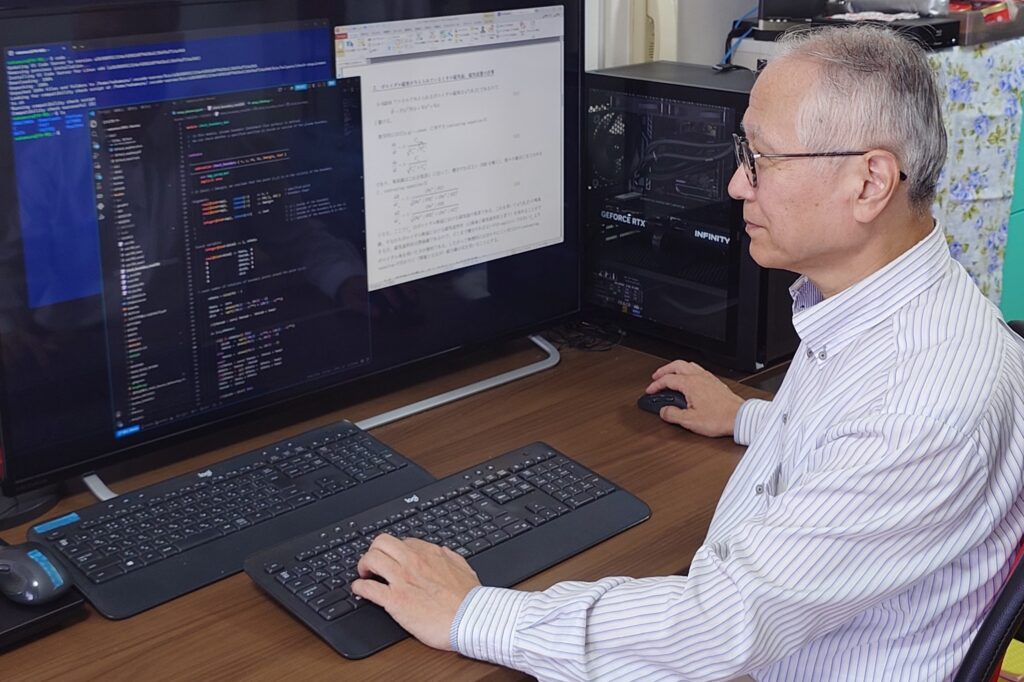
I am currently a member of the Science Department within the Technical Group, where my responsibilities include plasma performance assessment, predictive modeling, and the development of operational scenarios.
Plasma consists of charged particles, namely electrons and ions. Their motion generates electric currents, which in turn create magnetic fields. These magnetic fields then feed back on the plasma dynamics, sometimes causing instabilities or generating turbulence that degrades confinement performance.
Our role is to use advanced computational simulations to understand these complex behaviors and accurately predict plasma performance. Based on those insights, we develop operational scenarios that enable stable, efficient, and optimized plasma control.
In a commercial fusion power plant, plasma performance alone is not enough. The interactions between the plasma, surrounding structures, and plant systems are equally critical.
As a result, I am currently focused on developing and refining the computational tools needed for integrated plant analysis. I am also working extensively on simulations of fast-ion trajectories, including fusion-generated alpha particles, while accounting for three-dimensional effects arising from non-axisymmetric magnetic fields.
Q. Finally, what would you like to accomplish through the FAST Project?
When I was a student, I came across Challenge to Fusion by Professor Shoichi Yoshikawa, one of the pioneers of fusion research in Japan. Reading that book inspired me to enter the field.
Like many young researchers, I was captivated by the grand vision of creating a new energy source for humanity. Yet the path turned out to be far more difficult than I had imagined. For many years, fusion energy was often described as a distant dream, something that would always remain just beyond reach.
Today, however, the situation has changed dramatically. When I was a student, a fusion power plant existed only in computer simulations. Now, initiatives such as the FAST Project are bringing that vision closer to reality. What once seemed unimaginably far away is beginning to look achievable within our lifetimes.
Plasma confinement performance has already reached levels capable of producing and sustaining significant fusion reactions. We have now entered the next stage: the integrated development of fusion plant technologies.
At the same time, from both engineering and economic perspectives, further improvements in plasma efficiency and optimization remain critical challenges. By advancing plasma science through theory and simulation, while passing on our knowledge and determination to the younger generation who will lead this historic transition, I hope to contribute fully toward demonstrating fusion power generation in the 2030s.
The prospect of seeing fusion energy become a practical source of power within my lifetime is what continues to inspire me every day.